Recent Moth Awareness Events
By: Richard OBrien
This past month, DarkSky Colorado sponsored three moth awareness events: “Mothapalooza,” “Moth Magic,” and “A Big Day of Bugs.”
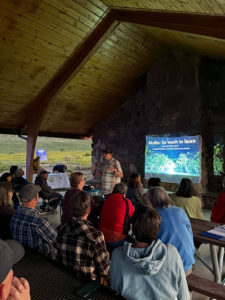
CU Professor Ryan St. Laurent gave presentations at “Mothapalooza” and “Moth Magic” June 4 and 11th.
The first two events involved moth observation at a Boulder County Open Space. Both featured the University of Colorado’s Assistant Professor of Entomology Dr. Ryan St. Laurent, who helped the guests learn about Colorado moths as nocturnal pollinators, and the variety of moth species that can be found in Colorado. These events were co-sponsored by DarkSky Colorado, People & Pollinators Action Network, the CU Museum of Natural History, and the Cottonwood Institute. Each of these organizations had informational tables with moth materials to discuss with guests. The evening culminated with moth viewing at several special moth viewing stations set up by moth research team members from CU Boulder.
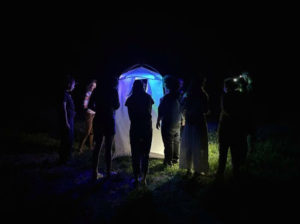
Guests look at moths at a special moth viewing station, set up by moth researchers from the University of Colorado, June 11, 2026.
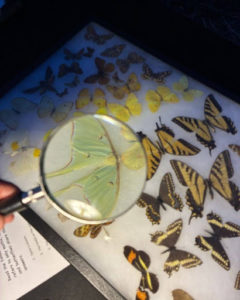
A display of moths, by the CU Museum of Natural History, a co-sponsor of “Mothapalooza” and “Moth Magic.”

DarkSky Colorado tables at the Denver Botanic Gardens “Big Day of Bugs” June 26, 2026.
“A Big Day of Bugs” was a day-long event at the Denver Botanic Gardens. DarkSky Colorado sponsored a table (along with 20 other organization tables) to help guests learn more about moths as nocturnal pollinators in Colorado. Displays featuring daytime pollinators encouraged guests to find daytime pollinators among the plants of the Botanic Gardens, and DarkSky Colorado’s display featuring nocturnal pollinators described what they might find in the Gardens after dark, and how these nocturnal insects perform pollination.
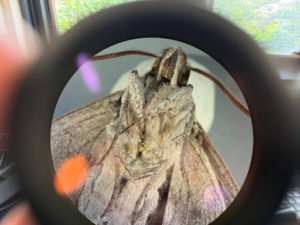
Guests at the Denver Botanic Garden’s “Big Day of Bugs” learned about how moths carry pollen. This closeup photo shows pollen grains on a moth’s underside. Photo by Christian Couch, the University of Colorado Boulder.
Research indicates that the impact of artificial light on moths is significant. In addition, research suggests that, surprisingly, artificial light is also affecting diurnal pollinators like bees. There is a growing body of evidence that artificial light has a large negative impact on all types of pollination.